
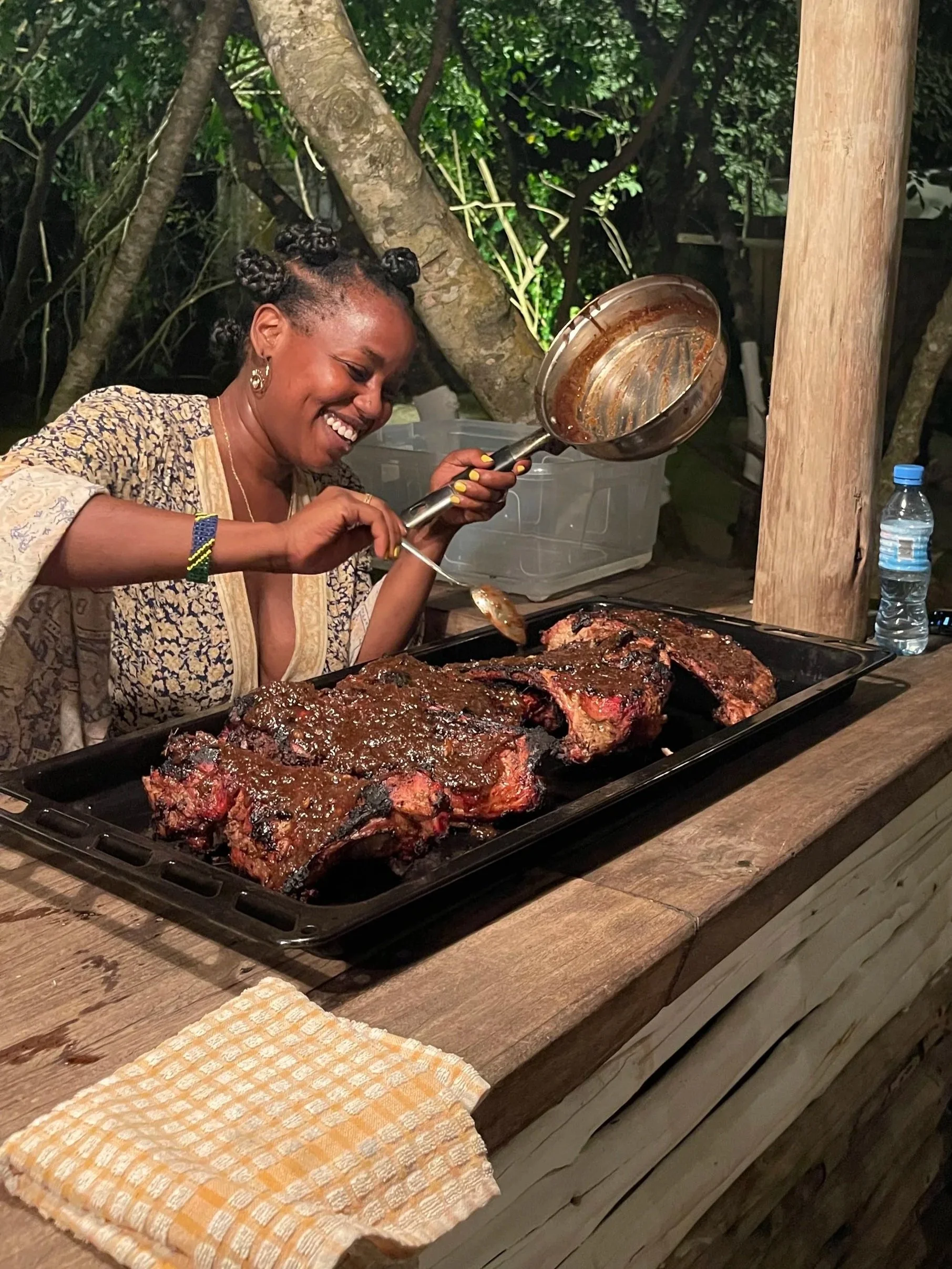
MEET JOCELYN
Jocelyn Salala is a Tanzanian-American chef, storyteller, and founder of Salala Stirs the Pot, whose cooking is rooted in the foodways of Tanzania and the Swahili Coast.
Raised in New York, in a Tanzanian family, Jocelyn grew up understanding food as more than something we eat. The table was where family gathered, culture was carried forward, and stories were shared. Those early experiences and a lifetime of returning to Tanzania continue to shape the way she cooks today.
Her food explores the movement of flavor across the Indian Ocean, the African continent, and its diaspora. Grounded in tradition but driven by curiosity, Jocelyn is interested in the connections between cuisines: how ingredients travel, how techniques evolve, and how food can tell us where we've been and who we've become.
Through Salala Stirs the Pot, Jocelyn brings that perspective to private dining, culinary experiences, recipes, cultural storytelling, and collaborations, all with one goal: to bring greater visibility to Tanzanian and Swahili food while inviting more people into the conversation.
THE ROAD TO THE KITCHEN
I DIDN'T TAKE THE TRADITIONAL ROAD TO BECOMING A CHEF.
My career began outside the kitchen, but food was always the thread running through my life. I cooked for the people I loved, traveled with food at the center of the experience, and kept returning to the flavors I grew up with.
SALALA STIRS THE POT STARTED AS A WAY TO SHARE THOSE STORIES. THEN THE KITCHEN KEPT CALLING.
What began with recipes, private dinners, and cultural food experiences grew into professional kitchens, menu development, and eventually my role as Head Chef at Flavors From Afar in Los Angeles.
TODAY, I'M BUILDING A CULINARY LANGUAGE ROOTED IN TANZANIA AND THE SWAHILI COAST. A LANGUAGE THAT CAN TRAVEL ACROSS AFRICA, THE DIASPORA, AND THE TABLES I COOK FOR.
The Swahili Coast has never existed in isolation. For centuries, the Indian Ocean connected East Africa with communities across Arabia, Persia, India, and beyond. You can taste that history in our food—in the spices, coconut, rice, breads, seafood, and techniques that define the coast.
That history shapes the way I think about cooking today. I’m interested in preserving what makes a dish culturally specific while also exploring the relationships between African cuisines and the wider diaspora.
Sometimes that means cooking something exactly as I remember it. Sometimes it means asking what happens when two traditions speak to each other.
The goal isn’t fusion for the sake of fusion. It’s connection.
I want my food to make people curious about Tanzania, the Swahili Coast, Africa, and the histories that connect our tables.
my point of view